Why native engine APIs?
Panels run against each AI engine directly, never through a reseller proxy, so what you see is what the engine actually said, reproducibly and at stated sample sizes.
Answerworthy works the way an honest analyst would: it asks the engines your buyers ask, reads your site the way AI crawlers read it, stores the raw evidence for every claim, and only then tells you what to change. Four layers, one ranked fix list. The discipline is called AEO (answer engine optimization); this is the tool that runs it on evidence.
Published by Answerworthy AI · Updated August 5, 2026
| Layer | The question it answers | How Answerworthy does it |
|---|---|---|
| Citation tracking | Are you in the answer? | Panels of real buyer questions run on each engine’s native API; citations and mentions are recorded per engine, per question, over time. |
| Crawler analytics | Is AI even visiting? | Not live yet, on the roadmap: verified AI-bot traffic on your domain, harvested from your CDN logs. What the scan observes today is reachability, your pages fetched as each bot. |
| On-site readiness | Can AI read what it finds? | 100+ deterministic checks covering crawl access, structured data, entity signals, answer liftability and site foundation, fetched as GPTBot, ClaudeBot and PerplexityBot. |
| Actions & proof | What do you fix first? | Every failed check and every lost answer becomes a ranked recommendation. When a fix ships, the next scan and the next panel run prove it. |
The claim on this page is that every number traces to evidence, so here is some. The report below is a real scan output, and the receipt next to it is this site's own public scan: Answerworthy runs on itself, in public, and links the result.
The crawler-side premise is measured too: in Vercel's crawler study, major AI crawlers executed zero JavaScript, which is why every check here reads your raw HTML the way the bots do.
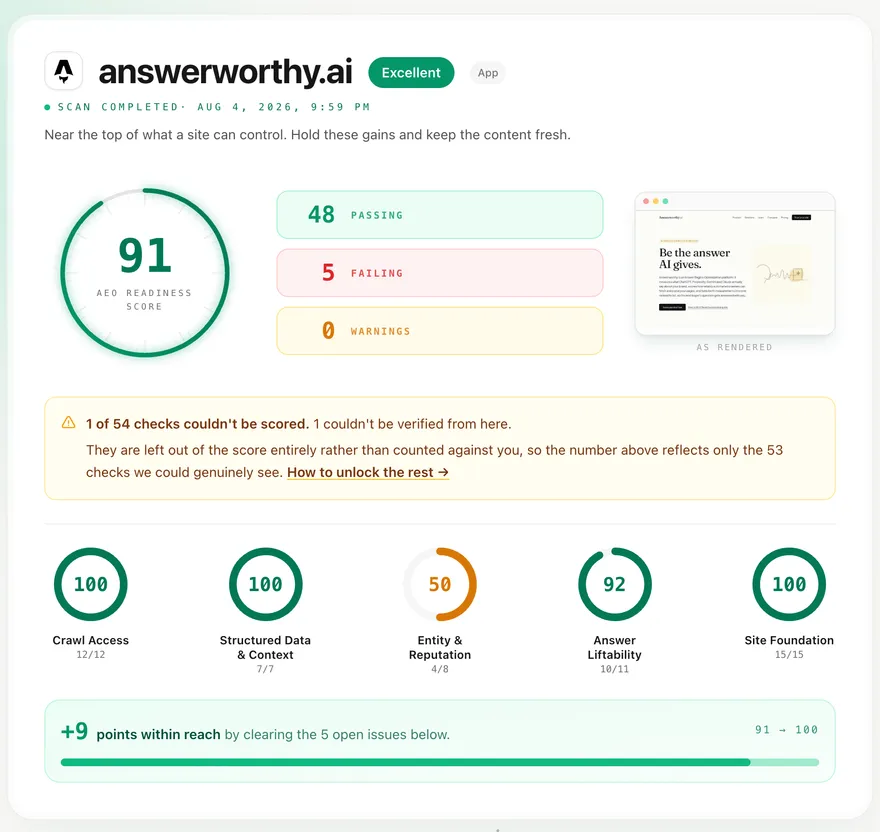
This site scores 91/100 on its own scan
OBSERVED scan 223ca334 · 2026-08-04
Open it: every check shows its verdict, its evidence, and its fix. That is the shape of every report the platform produces, and the methodology behind it is public.
Trust in a measurement tool comes down to how the numbers are produced, so the production rules are public: panels run on each engine's native API, every raw response is archived, and each finding is labeled by how it was established. The three cards below state those rules and what each one buys you.
Panels run against each AI engine directly, never through a reseller proxy, so what you see is what the engine actually said, reproducibly and at stated sample sizes.
Every engine answer is archived verbatim. Any number on any dashboard traces back to a stored response you can open and read.
When the platform cannot verify something directly, it says so: findings are labelled observed or inferred at the database level, never blended.
Buyers evaluating an AI visibility tool tend to ask the same four things: which engines are covered, how closely panel answers match what real customers see, what the platform costs, and whether citations can be guaranteed. The short answers are below, and the FAQ page carries the longer versions.
Answerworthy serves two kinds of teams: brands that own their AI visibility number in-house, and agencies that answer for it on behalf of clients. Both get the same measurement loop and the same evidence rules; the difference is workspace isolation, seat scoping and client-ready reporting on the agency side.
Start with the fundamentals inWhat is AEO? The complete guide, or go straight to the scan.
The free readiness scan is the product’s front door: your site, fetched as AI crawlers fetch it, scored with the fix list attached, in about a minute. It checks: